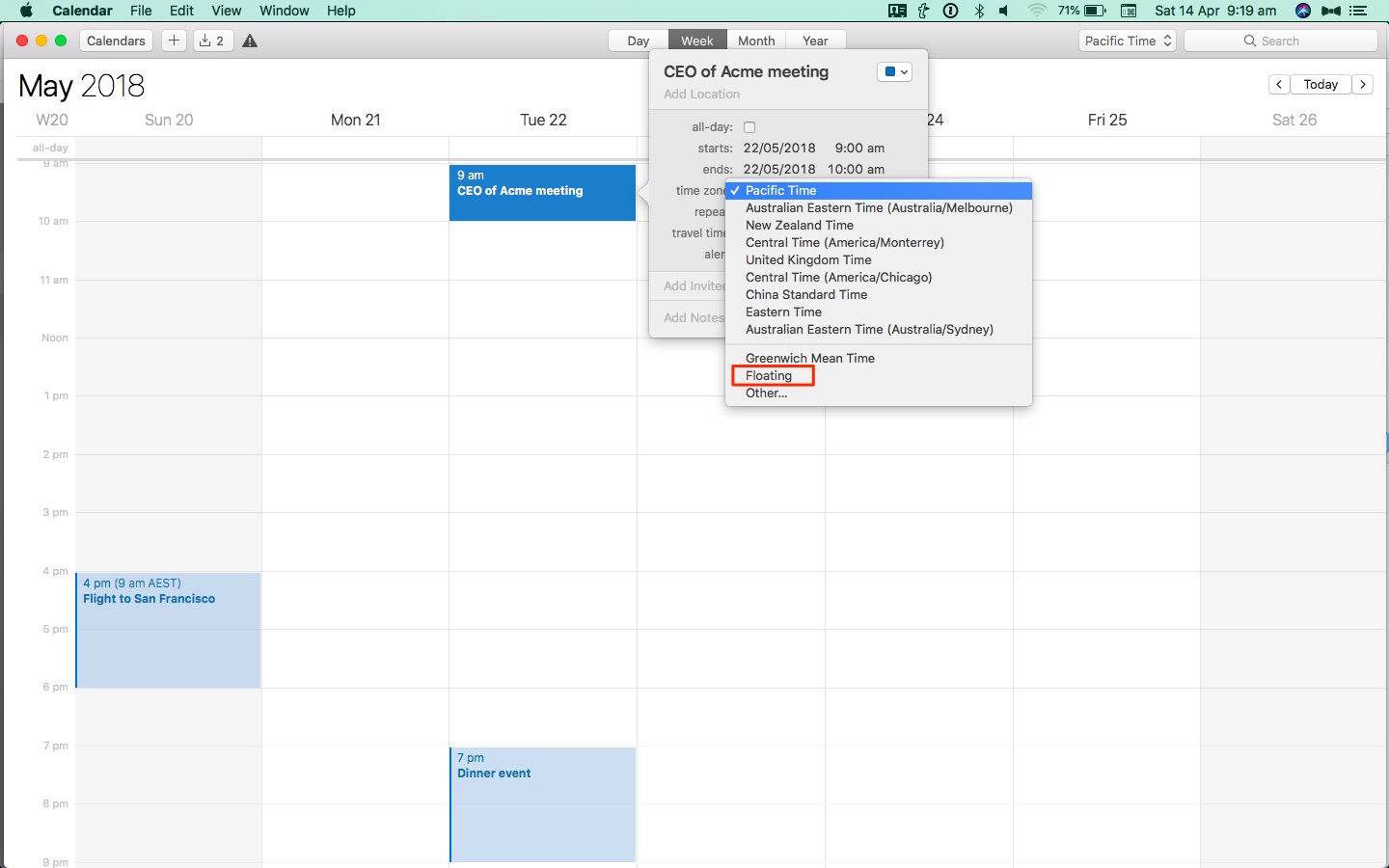
When I arrived in Auckland I set my iPhone's time zone to Auckland and it immediately added the two hours. Go to Settings -> General -> Date & Time
But when I looked at my iPhone calendar the events that were set to the New Zealand time were still showing in their Melbourne time slots. What had I forgotten to do?
Then I remembered I needed to set my calendar to the new time zone which can be found in Settings -> Mail, Contacts, Calendars and scroll down to Calendars and select Time Zone Support.There are many variations of this one. The idea here is that you can create your own story. What an idea?
Or you can drink yourself into a story, like Andy.
The flight from Melbourne to San Francisco really knocks me about. I've always suffered terribly from jet lag.
Probably about 10 years ago I organised for Paul Strassman to come speak at a conference I was organising in Canberra. Paul was probably in his 60s when he made the visit and I was amazed at how he seemed unaffected by jet lag. As I took him from meeting to meeting he never missed a beat. There was a couple of querks I noticed. For example at lunchtime Paul would say, "wherever we go I will need to have only protein, like a big steak." Then at dinner he would say, "We need to go somewhere we I can just have carbohydrates and nothing else, like a big bowl of pasta." I eventually learned that Paul was applying an anto jet lag diet devised by the US military and used by their diplomats. He had this dog-eared book that described the diet called Overcoming Jet Lag by Dr Charles F. Ehret and Lynne Waller Scanlon. I bought a copy on Amazon and have never looked back.
The book has modifications of a three step diet that changes depending on the number of time zones you cross and whether you are heading east or west. I recommend you get a copy of the book so you have all the background information on why this works and all the different diet variations. But to give you an idea of what the diet looks like, here is what they recommend for the flight from Melbourne to San Francisco.
FEAST = Generous servings
FAST = Limited servings (800 calories or so)
STEP ONE (preflight)
STEP TWO (morning of the flight)
STEP THREE (breakfast, destination time)
One of the reasons stories are memorable is that they can create an emotion within us which then kicks of a wave of body chemicals coursing through our veins. These chemicals ensure we remember the situations that created them. We remember what we feel.
I was reminded of this phenomena re-watching this remarkable documentary called A Class Divided. The participants in the experiment are unlikely to ever forget their experience with their teacher, Mrs Jane Eliot.
You can see the whole documentary on the PBS website in higher definition here
I'm intrigued at what people will stick on the back of their car, and go to some trouble doing it. I wonder what is says about the driver?
A nice storytelling cliff hanger to get us to click. From NeuroCooking
Save Rock Creek Hills Park!
Posted: 08 May 2011 02:26 PM PDT
We have been writing here less often, NeuroCooking friends, because another topic has been occupying us lately, a great deal really, since the night of April 28th, when, out of the blue, something shocking and terrible happened.
In fact, ...
* * * * *
On second thought, we would prefer not to go into the matter here. However, we would like to take the opportunity to direct your attention to it.
And so, please, might we direct your attention to:
http://SaveRockCreekHillsPark.org
And to the facebook page "Save Rock Creek Hills Park".
Thank you for your understanding, and your interest.
Thanks to Kevin Bishop for the link.
Last week I spent a couple of days with 16 or so amazing folk all drawn together for a retreat by my friends Viv McWaters and Johnnie Moore. I hastily responded to Viv's invitation when it arrived to count me in. I knew some of the people who were coming and I could see it would be interesting and fun. I was looking for a battery recharge and I felt the group would be a positive jolt.
Viv and Johnnie have been travelling together through Asia for the last few weeks teaching people to be better facilitators and their general approach is to eschew planning and be guided by what the group wanted to do. Notice more, do less is Johnnie's maxim. As a result there was a sense of anticipation throughout the 2 days--what might happen next? There was probably a bit of "What in the hell are we doing?"
Coming to the retreat I knew there would be improv games: Viv and Johnnie are expert improv facilitators. The thing is, I wasn't interested in doing that. I was hoping for some really interesting conversation. I wanted to hear about people's experiences. So I jumped into a couple of games but mostly avoided them and tended to find a side conversation to join. The retreat was a bit like open space without the process.
I noticed that when we were in one single group we struggled to talk. A good amount of time was spent looking at each other in silence waiting for the next utterance. As you might guess the conversation was best when we spun off into smaller groups. I had a terrific conversation with Sam, Geoff and Karen at the Martians cafe. It was a highlight. I wonder whether we should have done more of this and maybe even constructed some process to facilitate it, such as a world cafe. I know Viv and Johnnie were experimenting with their processless approach so rather than suggest one I was happy to just notice what was happening.
I learned a couple of things from the weekend that are still buzzing around my head. I remember being at the berry farm and at my table there was Viv, Sam, Johnnie, Geoff and Nicky. It was just before we were finishing the retreat. I asked them what stories would they remember for the two days and Viv said she would remember occilating between anxiety and letting go. I said that wasn't really a story but an abstraction of what happen and asked whether Viv could recount a specific moment that illustrated what she meant. Viv then said, "sometimes stories are dangerous and it's safer to share the abstract." What a great insight. Even writing this reflection there is a story I would like to share but I will hold it back because it needs to be told to the person involved directly.
Years ago I was told that when an outcome was clear then the process could be ambiguous. And when the outcome was unclear then the process to get there is should be well crafted. The retreat's outcome and process was unclear and this left us floating for much of the time. I didn't mind that too much. I wouldn't liked some more process.
Nicky showed me how a simple story game could create a facinating conversation. I came in late to this one but they were playing story of a body part. Nicky would turn to a participant and say, "tell me a story about your neck." The person would pause for a while and then out would pop a story which may or may not be entirely on topic but totally entertaining, insightful and drew us together and built trust.
I felt there was a real tension for the facilitators not wanting to lead and hoping for emergence and all the participants looking Viv and Johnnie for leadership. It was quite funny how on one hand Johnnie was clearly wanting to be low status and then would blurt out something like "I don't want to do this, I'm bored. Just telling you what I feel," and so we didn't do that. It how it was said that reinforced status and Johnnie role as co-host. I think we have very deeply held mores about the role of hosts and guests. I wondered if that gets in the way of a no-faciltation retreat? (I hope you don't mind me telling this story Johnnie. Everyone should know that this little moment wasn't a reflection of how Johnnie guided the group for the rest of the time. I absolutely admire his approach and intelligence. It's just the remarkable things that provide insight."
I hope I get invited to another Viv and Johnnie retreat.
Sent from my iPhone